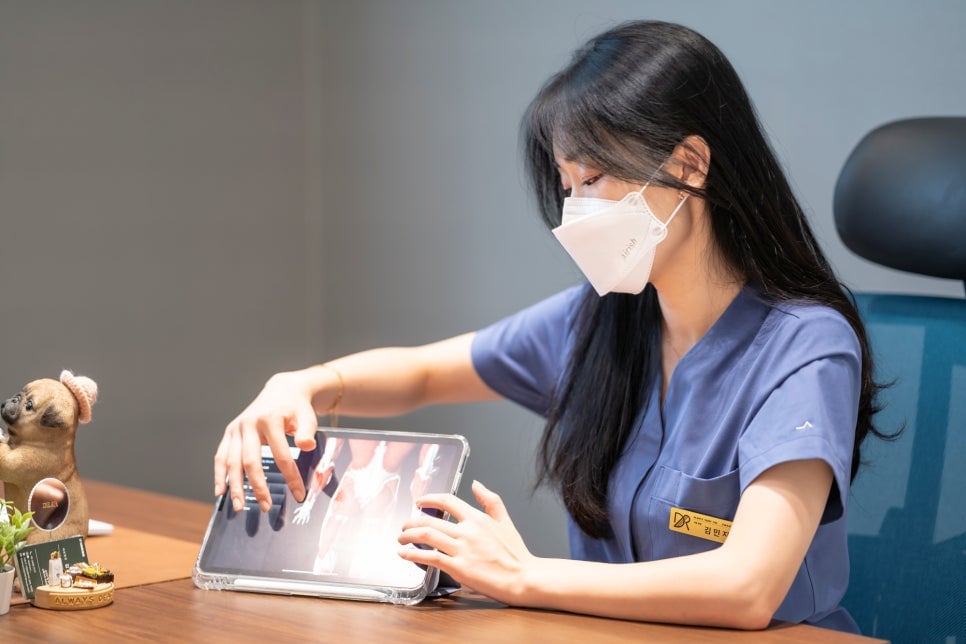
Whether you are planning skin care into a trip to Seoul or your skin changed after moving here, the question I start with is the same: what exactly is on your skin today?
ONE WORD
Three problems under the word "acne"
"I have acne" can mean a cluster of sore red bumps along the jaw, a cheek that is calm now but still blotchy, or skin that feels uneven under makeup. These are different stages of the same story, and they respond to different things.
Inflamed breakouts
- What you see
- Red raised spots (papules), spots with a white head (pustules), deeper sore lumps.
- What I use
- Pharmacopuncture into the spot, facial acupuncture, extraction. A short herbal prescription when they keep returning.
Red and brown marks
- What you see
- Flat pink or red marks, or flat brown spots, where a breakout has healed.
- What I use
- Medical microneedling with an ampoule chosen for redness or tone, radiofrequency, a calming mask and LED.
Acne scars
- What you see
- Small dips in the skin: narrow and deep, rounded and shallow, or wide with steep edges.
- What I use
- Fine needles to loosen the hardened tissue under each scar, then ampoules and pharmacopuncture.
Two or three of these can sit on the same face. Treating everything with one method is how you end up calming the spots while the marks stay, or working on scars while new breakouts keep adding to them. The order matters as much as the method: settle what is inflamed first, then work on what it left behind.
NOW · EXPECTED
What changes, and what stays
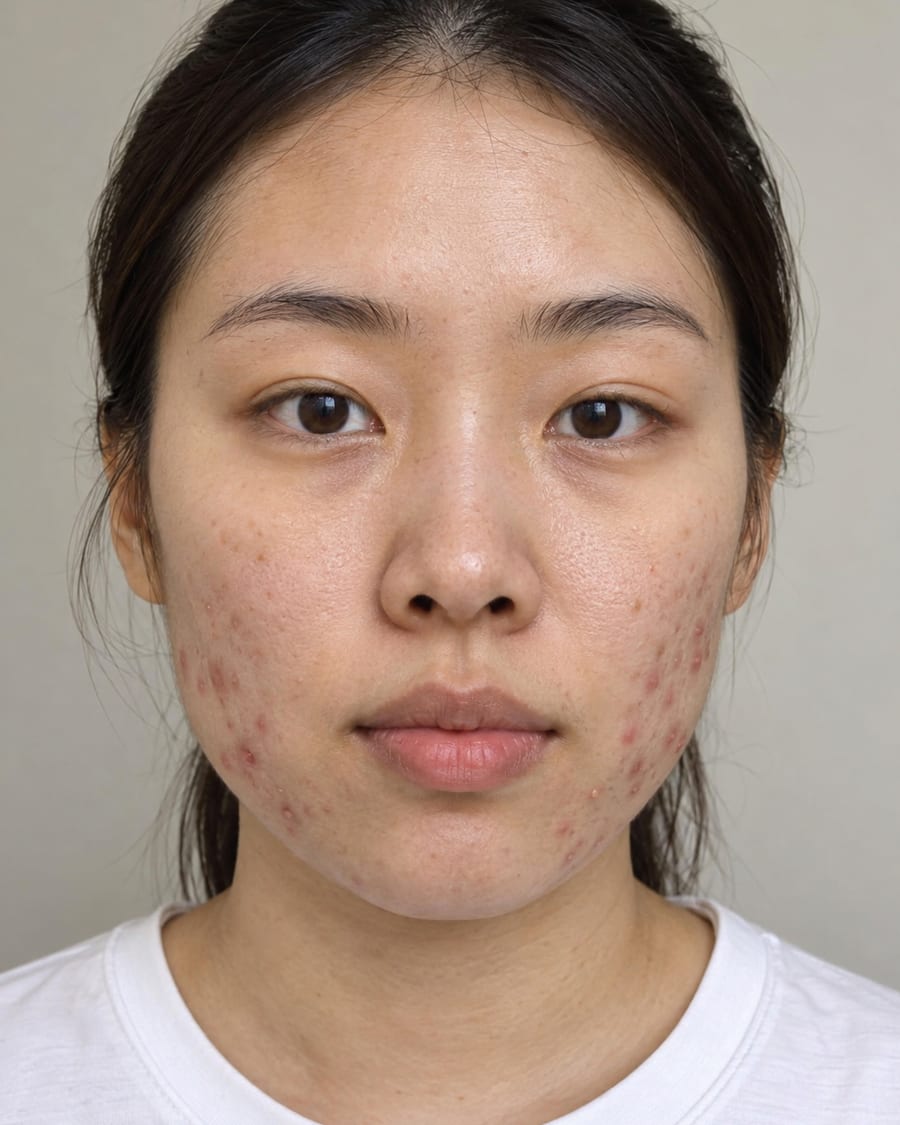 123
123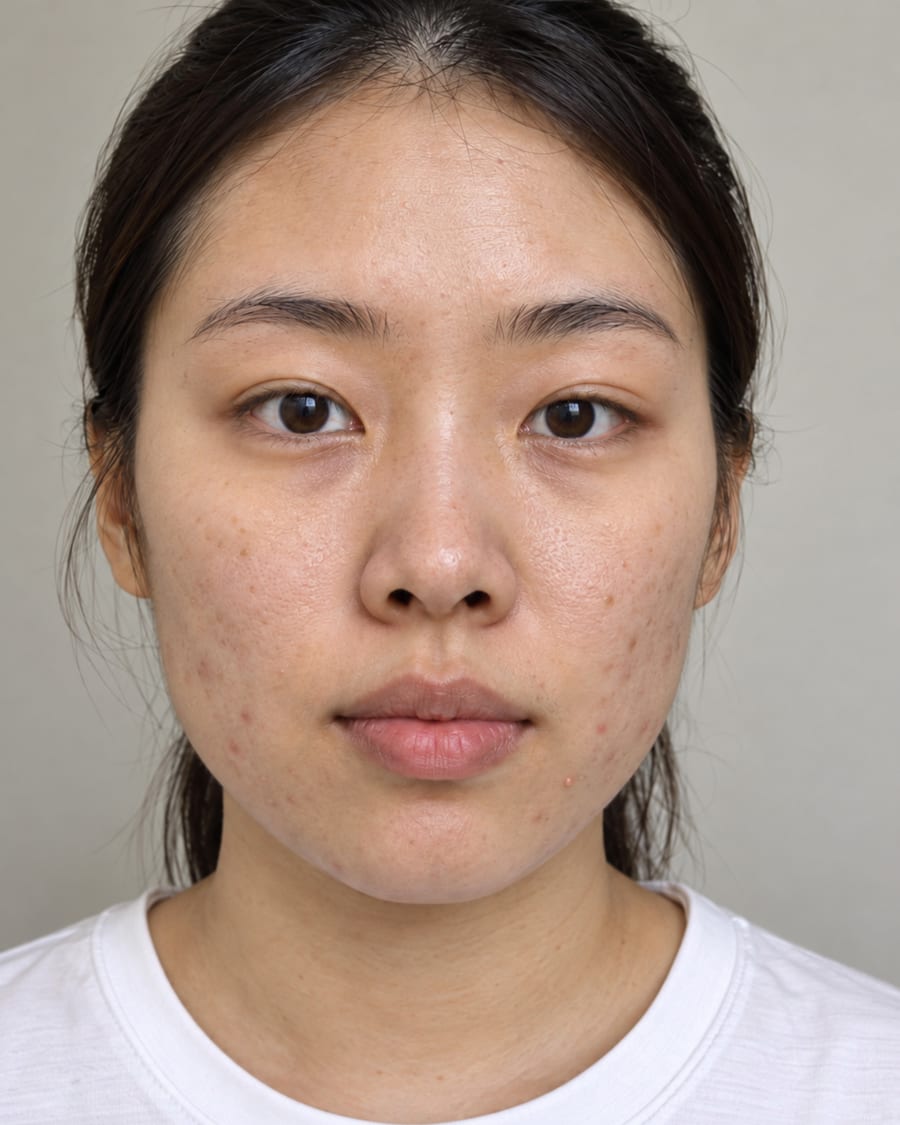
- Inflamed papules
A cluster of red, raised, tender spots on the lower cheek, with a few new ones forming.
Pharmacopuncture into the spots and facial acupuncture calm the inflammation first; most settle, and one or two small ones may still be fading.
- Post-inflammatory redness
Flat pink-red marks where spots have healed, mixed in with a few active ones.
Once no new spots are adding to them, microneedling with a calming ampoule and LED help the red fade; it lightens week by week rather than all at once.
- Post-inflammatory hyperpigmentation
Small flat brown dots higher on the cheek, left by older breakouts.
These lighten more slowly than redness and can stay faintly visible; starting early and protecting the skin from sun helps them fade.
An AI-generated example image, not a patient.
Read what patients say about DEAR
WHY NOW
Has your skin always been like this, or did it change?
When someone sits down with me about acne, they usually fall into one of two groups, and the answer shapes everything that follows.
Skin that was prone to inflammation or allergy from a young age tends to stay reactive into adulthood. Calming the surface with pharmacopuncture and facial acupuncture helps, but without working on what keeps setting it off, the same spots return. This is where an herbal prescription matched to your constitution comes in.
Then I ask what changed. The usual suspects:
- stress and short sleep
- your menstrual cycle
- hormonal medicine, such as the pill
- digestion and bowels
- a sudden change in climate
- new water after a move or a trip
- wearing a mask more
The second list is not abstract to me. Some years ago, after opening the clinic, I went through a stretch of short nights and constant worry. I wore a mask all day, and my forehead, the only part still showing, filled with small, hard, inflamed spots. My patients' eyes kept going to it, and so did mine every time I passed a mirror. My skin had been clear as a child; stress had simply found its way out. I treated it the way I would treat a patient: a prescription to ease the tension that had built up and to bring down the heat rising to my face, alongside acupuncture.
Adult acne is common, and more so in women. In a survey of 1,013 adults, 35.2% of women in their 30s and 26.3% of women in their 40s reported acne, against 20.1% and 12.0% of men (Collier et al., 2008).
If you moved to Seoul recently, the water, the dry winters, a new job and a different sleep schedule all arrive at the same time. That is often enough to tip skin that was managing fine.
AT DEAR
What I do, and why I do it myself
I see every patient myself, at the first visit and at each follow-up, and a first consultation runs about 40 to 60 minutes. I look at where the breakouts sit, whether they are surface spots or deep and sore, how much redness and pigment they have left, and whether there are scars, and I ask about your cycle, sleep, digestion and anything you are already using or taking.
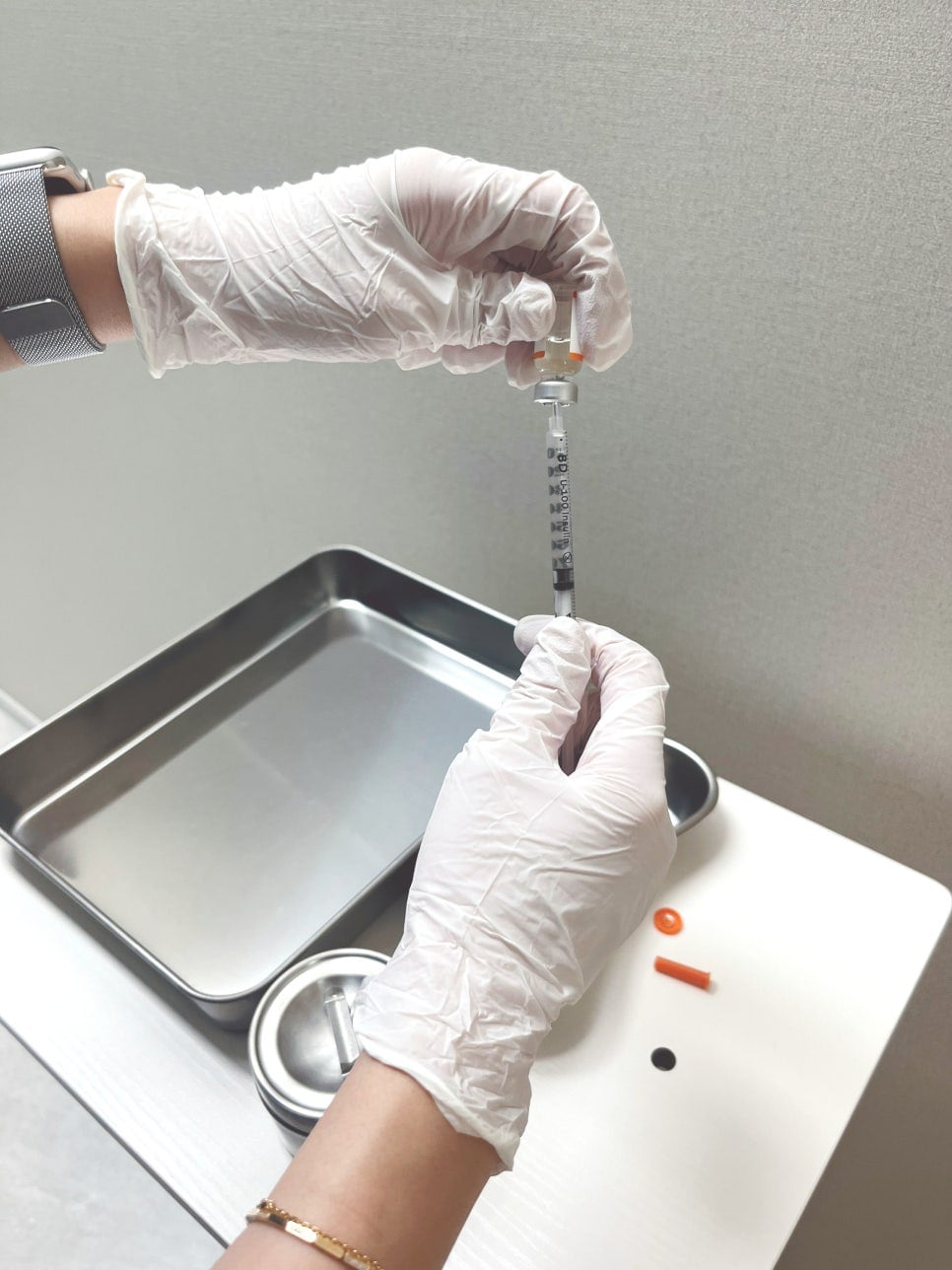
Pharmacopuncture places a small amount of an herbal solution directly into an inflamed spot to bring the inflammation down where it is, rather than across the whole face.
Medical microneedling (A-MTS) uses an automatic device that makes fine, vertical channels, so the skin rebuilds collagen as it heals. Because I perform it myself, I can set the depth for each area of your face, from 0.5 to 1.5 mm, and choose the ampoule at the consultation: for repair and brightening, for firmness and collagen, or for calming inflammation and redness. Exosome ampoules are one of the options.
Radiofrequency, extraction and a calming mask with LED light are added when they help.
Breakouts on the back and chest are treated the same way. When acne has gone on for a long time or keeps returning, I add a small herbal prescription to address what is driving it. If you are already using a cream or taking a medicine for your skin, bring the names; we plan around them.
More on the ampoules, including exosomes, is in Exosome Treatment in Korea.
SCARS
Acne scars: why I loosen them from underneath
A scar forms when a deep breakout heals but the skin does not return to what it was: the tissue underneath turns fibrous and hard and pulls the surface down. How it looks depends on how deep and how wide the damage went.
Narrow and deep, like a puncture.
Rounded and shallow; common on the cheeks and under the jaw.
Wide with steep edges, often where breakouts returned to the same spot.
Several types side by side.
Regenerating ingredients work better once the hard tissue holding a scar down has been released, so I start by loosening that tissue: a fine needle can be angled sideways as well as down, which lets it reach the bands under a scar from several directions and release them. Then ampoules and pharmacopuncture support the skin as it fills the space. It does not shave the surface or heat the skin intensely, you do not need anesthesia, and you can return to your day right after.
Scars are slower work than active spots, and the sooner deep breakouts are treated, the fewer scars there are to work on later.
THE LONGER READ
RESEARCH
What the research supports
Acupuncture, which I use on inflamed spots, has been tested head to head against the standard drugs. A 2018 review pooled ten randomized trials in which acupuncture or ear acupressure was compared with guideline acne medicines: the share of people whose lesions fell by at least 30% was much the same in both groups (risk ratio 1.07), and side effects were fewer with acupuncture (Mansu et al., 2018). That is part of why I start inflamed spots with needles, and why someone who would rather avoid oral drugs is not choosing the weaker option.
For scars, what shapes my plan is less whether microneedling works than what goes with it. On its own it already improved acne scars more than the treatments it was compared with across 12 randomized trials with 414 people, and brown post-inflammatory marks came out in its favor too (Shen et al., 2022). Where it was combined with a regenerating agent, results went further: with platelet-rich plasma, a better-than-half improvement was about three times as likely as with microneedling alone, usually over two to six sessions (Kang and Lu, 2021), and a 2024 network analysis of 24 trials ranked combinations ahead of microneedling on its own (Li et al., 2024). The research has moved toward pairing microneedling with something that supports repair, and that is the direction I take with ampoules.
For skin that darkens easily, radiofrequency earns its place. Compared with laser in eight trials, fractional radiofrequency improved scars to a similar degree with far less darkening afterward (risk ratio 0.12) and shorter redness (Li et al., 2022).
Brown marks need more patience than people expect. Among 324 acne patients in seven Asian countries, 58.2% had post-inflammatory pigmentation (Abad-Casintahan et al., 2016). It is the strongest reason I know to treat inflamed spots early and leave them unpicked: every breakout that settles quickly is one less mark to fade later.
TRAVEL
Planning around a trip, a wedding or a photoshoot
Tell me your dates at the consultation: when you land, when you fly home, and any event in between. Inflamed spots can be treated within a short stay; marks and scars take a series of sessions, so if you are visiting, we choose what to prioritize within the days you have, and if you live in Seoul, we set a schedule you can keep.
If acne has been part of your skin for years, or it changed after a move, the place to start is someone looking at it closely. I will see you myself, in English, and we will decide together what to treat first.
DEAR KOREAN MEDICINE CLINIC
About a 10-minute walk from Gangnam Station Exit 5 · +82-2-3486-1777
- Mon·Tue·Wed·Fri10:00–20:00
- Lunch13:00–14:00
- Thu14:00–20:00
- Sat10:00–15:00
- SunClosed
FAQ
Frequently asked questions
Does acne treatment with needles hurt?
You will feel it, because facial skin is thin; the needles used on the face differ in length, thickness and material from those used on the body. Scar work does not need anesthesia, and you can go back to your day afterward.
How many sessions will I need?
It depends on what you have and how quickly it settles between visits. Inflamed spots come first; marks and scars take a series of sessions. After the first consultation I tell you what I would treat first and how often.
Can I start during a short trip to Seoul?
Yes. Tell me your arrival and departure dates when you book, and we plan what can be done within your stay.
Do you treat back and chest acne?
Yes. Breakouts on the back and chest are treated with the same approach as the face.
I already use acne cream or medicine. Can I still come?
Yes. Bring the names of what you use or take, and we plan the treatment around them.
Can I have my consultation in English?
Yes. Director Minji Kim consults directly in English, Japanese and Chinese, so you won't need an interpreter.
How do I book?
Appointments are given priority, so we recommend booking before your visit. The most reliable way is an Instagram DM to @dearhani__, or you can call us at +82-2-3486-1777.
Sources
- Mansu SSY, Liang H, Parker S, et al. Acupuncture for Acne Vulgaris: A Systematic Review and Meta-Analysis. Evid Based Complement Alternat Med. 2018;2018:4806734.
- Shen YC, Chiu WK, Kang YN, et al. Microneedling Monotherapy for Acne Scar: Systematic Review and Meta-Analysis of Randomized Controlled Trials. Aesthetic Plast Surg. 2022;46(4):1913–1922.
- Kang C, Lu D. Combined Effect of Microneedling and Platelet-Rich Plasma for the Treatment of Acne Scars: A Meta-Analysis. Front Med (Lausanne). 2021;8:788754.
- Li H, Jia B, Zhang X. Comparing the efficacy and safety of microneedling and its combination with other treatments in patients with acne scars: a network meta-analysis of randomized controlled trials. Arch Dermatol Res. 2024;316(8):505.
- Li J, Duan F, Kuang J. Meta-analysis of fractional radiofrequency treatment for acne and/or acne scars. J Cosmet Dermatol. 2022;21(12):6754–6766.
- Abad-Casintahan F, Chow SK, Goh CL, et al. Frequency and characteristics of acne-related post-inflammatory hyperpigmentation. J Dermatol. 2016;43(7):826–828.
- Collier CN, Harper JC, Cafardi JA, et al. The prevalence of acne in adults 20 years and older. J Am Acad Dermatol. 2008;58(1):56–59.
This column is general health information and does not replace an individual diagnosis. Results vary from person to person.